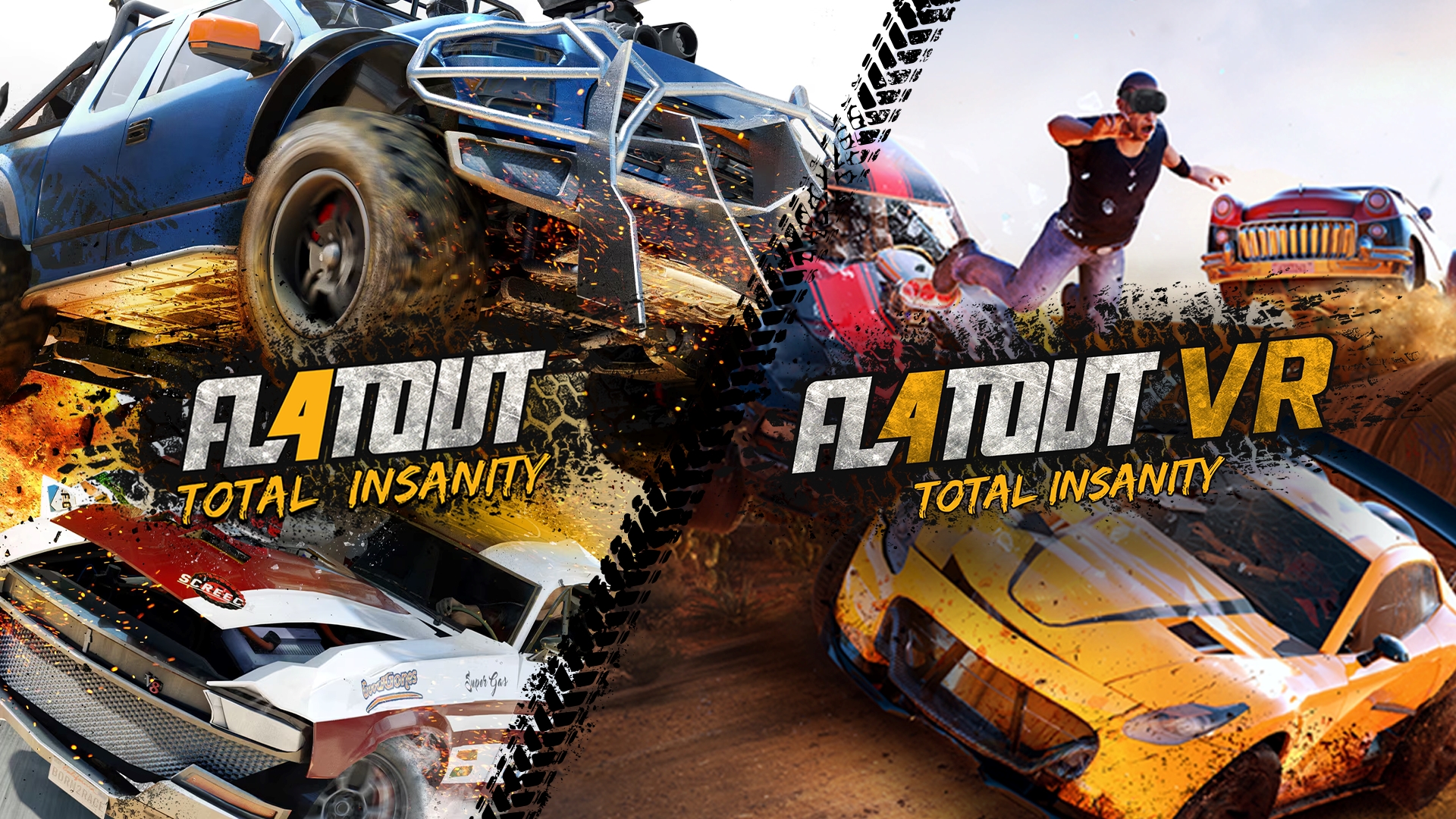
An ambitious vision, an unexpected detour, and a whole lot of wrecked cars. The road to FlatOut 4: Total Insanity VR has been anything but predictable.
There's a moment in every FlatOut race when the planned route stops mattering. A rival cuts across your hood, a guardrail gets dangerously close, and suddenly you're improvising. As it turns out, bringing FlatOut into VR would require a similar talent for changing course.
What began as an ambitious idea for the entire franchise eventually took shape as FlatOut 4: Total Insanity VR, the first release under our Flat2VR Spark initiative. Along the way, the project took some unexpected turns, grew well beyond its initial scope, and began incorporating ideas that seemed strangely familiar to those of us who remembered where this whole thing started.
How did we get here? Well, that's a bit of a story.

The Original Ambition
In August 2024, when we announced the formation of Flat2VR Studios, we revealed several projects that would help establish our vision for bringing beloved flatscreen games into VR. Among them were Trombone Champ: Unflattened, Roboquest VR, WRATH: Aeon of Ruin VR, and something we were calling FlatOut VR.
And we had some pretty big ideas for that last one.
Our initial vision was to explore the possibility of creating a VR experience that celebrated the best of the entire FlatOut series. Imagine taking favorite elements from across the franchise and bringing them together in one definitive VR racing experience. The cars, the tracks, the handling, the physics, the spectacular crashes, and the completely unreasonable things you could do to a perfectly good automobile.
For fans of FlatOut, it was a pretty exciting prospect. It was exciting for us, too. The idea was still taking shape, and we hadn't settled on a final design or even an official name, but the possibilities were hard to resist.
Judging by the reaction from our community, we weren't alone. FlatOut VR quickly became one of the projects people were most eager to hear about. Players wanted to know which games we'd draw from, what the driving would feel like, and, naturally, how much destruction they could cause with a headset strapped to their face.
There was certainly no shortage of enthusiasm. Unfortunately, enthusiasm alone doesn't get a car across the finish line.

An Unexpected Roadblock
As we started exploring the technical requirements of bringing FlatOut into VR, we discovered that the project would be considerably more complicated than we'd initially hoped. The games presented some significant technical challenges, and addressing them would require specialized expertise.
Meanwhile, Flat2VR Studios was already busy bringing its other announced projects to life. We were a young studio working across multiple games, with development schedules and commitments that required our attention. Every new opportunity had to be weighed against the work already underway, and although we were eager to get FlatOut moving, finding the right path forward was proving difficult.
For a period, the prospect of bringing any official FlatOut game into VR was genuinely uncertain. That's a frustrating position to be in when you have a community asking for a game you desperately want to make.
But the right opportunity can sometimes come from an unexpected direction.
Ours arrived in the form of a developer named Mutar.

A Spark Behind the Wheel
Mutar, also known as NoMoreFlat, brought the kind of specialized technical experience we needed to tackle the challenges of adapting FlatOut for VR. He was exactly the kind of developer we had been looking for, and as luck would have it, we were also developing a new way to work with talented people like him.
By this point, Flat2VR Studios was encountering more opportunities to adapt established games than our traditional development pipeline could reasonably accommodate. That presented an interesting question: What if we could create another path for talented independent developers and modders to pursue these projects, with access to official game assets, source code, and the production resources of an established studio?
It was an idea that brought us right back to our roots.
Flat2VR began as a modding community, built by people who loved games enough to spend their own time finding ways to experience them in VR. That spirit of experimentation had helped bring our studio into existence. Now, we wanted to create more opportunities for those kinds of creators to contribute to officially licensed releases.
And so, Flat2VR Spark was born.
The initiative gives specialist developers the opportunity to lead VR adaptations while Flat2VR Studios provides support across licensing, development resources, quality assurance, publishing, platform requirements, and the other challenges of bringing a commercial release to market.
For FlatOut, it provided the opening we'd been looking for. Mutar began developing an official VR adaptation of FlatOut 4: Total Insanity, with support from Flat2VR Studios. The project had a more focused scope than the broader experience we'd originally imagined, but it offered something we'd been working toward for quite some time: a real, playable FlatOut game in VR.
In August 2025, we announced FlatOut 4: Total Insanity VR as one of the first titles under the new Spark banner. Naturally, our community had questions. What happened to the original FlatOut VR concept? Why were we adapting FlatOut 4 specifically? And what about the other VR platforms we'd discussed in our original announcement?
Fair questions, all of them.

When FlatOut 4 VR launched into Steam Early Access on May 7, 2026, we followed up with a video explaining how the project differed from our earlier vision. We acknowledged that our communication could have been clearer and explained that FlatOut 4 VR was a distinct project with its own development path. The larger concept we'd discussed remained an idea we were interested in exploring, and we had no further announcements to make about it at the time.
For now, we had something considerably more immediate to celebrate. After all the uncertainty surrounding the original project, players could finally climb behind the wheel of a FlatOut game in virtual reality.
And what a difference a headset makes.
Suddenly, those spectacular crashes were happening around the cockpit. Rival cars were sliding past your windows, debris was flying through your field of view, and every near miss felt close enough to make you instinctively lean away. Mutar had brought the original game's destructive arcade racing into VR with full six-degrees-of-freedom support, reworked vehicle interiors, physical steering options, racing wheel and pedal compatibility, spatialized audio, and much more.
The demolition derbies, outrageous stunts, and high-speed pileups were all there. Only now, you were sitting in the middle of them.
And as players started getting their hands on the game, something interesting happened.

When the Community Took the Wheel
The response to the Early Access release was enormously encouraging. Players were sharing clips of spectacular crashes, discussing their favorite moments, posting reviews, and offering feedback about everything from controls and performance to hardware compatibility.
And they had plenty to say.
One of our earliest challenges involved steering wheel support. Anyone familiar with PC racing setups knows that the variety of available hardware is almost absurd. Different wheels, pedals, shifters, manufacturers, configurations, and combinations can make compatibility an adventure all its own.
Our community was eager to help. Players tested their equipment, submitted diagnostic reports, discussed issues directly with the developers, and helped us identify what needed attention. Within a week of launch, that collaboration helped expand wheel compatibility from a handful of configurations to hundreds of unique setups.
It was an impressive example of what can happen when a passionate community works directly with the people developing a game. But something else was happening behind the scenes.
We were becoming increasingly invested in FlatOut 4 VR ourselves.
The enthusiasm surrounding the project was contagious. Players loved what they were experiencing, and our own team was having an absolute blast with the game. We started imagining how much further we could take it.
While Mutar had led development of the original Early Access release, Flat2VR Studios began committing additional resources to the project. Our internal team took on a larger role, developing most of the improvements and new features introduced throughout the Early Access period. And the more we worked on the game, the more ideas we had.

Some of our developers even began experimenting with additional features in their spare time, simply because they thought those features would be fun.
That's one of my favorite things about this story. Here we were, an official development studio working on a licensed commercial game, and some of the people behind it were approaching the project with the same curiosity and enthusiasm that had driven the Flat2VR modding community in the first place.
Someone would imagine a feature that might make the game more entertaining. Then came the question of whether we could actually make it work. Sometimes, the answer turned into something players could enjoy.
Soon, FlatOut 4 VR was expanding in directions that went well beyond our original plans. We continued refining the fundamentals, improving steering, performance, multiplayer, and the overall VR experience. But we also started building things the original game had never offered.
By the time we were preparing for version 1.0, the list had become rather substantial.

The Unexpected Destination
On October 23, 2026, FlatOut 4: Total Insanity VR officially crossed the finish line of Early Access and reached version 1.0. We wanted the full release to feel like a meaningful milestone, reflecting the work that had gone into the game since May while giving players a taste of our continuing ambitions.
So we packed quite a lot under the hood.
Multiplayer received one of the biggest upgrades. We completely reworked the lobby system, making it easier to find and join races. Players can now enter sessions already in progress, spectate the action, and even climb into the passenger seat of another player's car. Because sometimes it's nice to experience a spectacularly bad driving decision without being the one responsible for it.
We also introduced AI-filled starting grids and automatic host migration, allowing multiplayer sessions to continue when a host disconnects.
We expanded the ways players can experience the wreckage, too. Alongside continued improvements to steering wheel compatibility and controls, version 1.0 introduced bHaptics support and motion rig compatibility. We refined the mirrors, reworked menus and interface interactions, improved performance, and continued polishing the experience behind the wheel.
And then we started having a little fun.
You know those infamous FlatOut moments where a particularly brutal collision sends your driver flying through the windshield? You can now experience that from the driver's perspective. When things go catastrophically wrong, you get to enjoy a first-person view of your own unscheduled departure from the vehicle.
Seatbelts are apparently optional.

Then there's Experimental Mode. Among its additions are handheld firearms that allow players to shoot at opponents with one hand while steering with the other. Because the problem with demolition racing was clearly that it wasn't dangerous enough.
We also added some unexpected new vehicles, including a motorcycle and the van from Roboquest. Yes, that Roboquest. Apparently, even our other games aren't safe from getting dragged into the mayhem.
But perhaps the most interesting additions are the ones that should feel especially familiar to longtime FlatOut fans.
We started bringing elements of FlatOut 2 into the mix.
A vehicle from the fan-favorite sequel joined the garage, along with two of its tracks. Players can also choose optional physics and opponent AI settings inspired by FlatOut 2, experimenting with different handling and racing behaviors.
Sound familiar?
It certainly did to us. Because if you rewind all the way back to our original announcement in 2024, you'll remember that we'd been imagining a VR game that could bring together some of the best elements of the entire FlatOut franchise.
That was the big idea. Then came the technical challenges, the changing development plans, and the creation of Spark. When FlatOut 4 VR finally arrived, we'd made a point of explaining that it was a different project, with its own identity and direction.
And now, here we were.
A car from FlatOut 2. Tracks from FlatOut 2. Its physics and AI joining the available options. Entirely new VR features and multiplayer functionality expanding the experience beyond what the original FlatOut 4 had offered.
Somewhere along the way, elements of that original, series-spanning vision had found their way into the game after all.
There's a wonderful irony in that. The project we'd taken such care to give its own identity had begun borrowing ideas from the much bigger concept that preceded it. And it happened because the people involved kept finding more things they wanted to create.
The players kept sharing their experiences and ideas. The developers kept experimenting. The studio continued investing additional time and resources into a project that had captured our enthusiasm. And gradually, the possibilities grew.
FlatOut 4: Total Insanity VR remains its own project, with its own development path. But looking at what we've already added, it's easy to recognize the influence of those original ambitions.
In some ways, we've come full circle.

Flat2VR began with people tinkering with games they loved, driven by the simple desire to experience something familiar in an entirely new way. Through Spark, that passion helped get FlatOut 4 VR onto the starting grid. And through the enthusiasm of our developers and community, it's continuing to shape what the game becomes.
We included so many additions in version 1.0 because we wanted players to see the kind of creativity and ambition driving our work on the project. There are plenty of ideas we're still exploring, and we'll have more to share when the time is right.
For now, FlatOut 4: Total Insanity VR is available on SteamVR, with the PlayStation VR2 version also in development.
It's been a long road from that first announcement in 2024. A few unexpected turns. Some difficult obstacles. More than a few spectacular crashes. And somewhere along the way, we ended up recognizing the road we'd originally imagined.
We've crossed the finish line of Early Access.
We're nowhere near done racing.
